Governing rural communities
Class 6th Social Science
13. Governing Rural Communities
Orient Black Swan Publication
iv. Answer the following questions
1. What is the meaning of local self-government? How is it important in a democracy?
Answer: Local self-government means governing local areas through elected representatives who understand local needs and problems. It is important in a democracy because it encourages people’s participation, makes administration more responsive, promotes accountability, and helps solve local issues quickly and effectively through decentralisation of power.
2. What are the three levels of the Panchayati Raj system?
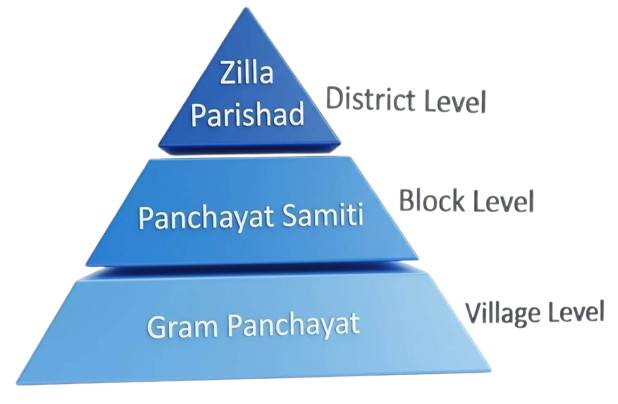
Answer: The Panchayati Raj system has three levels: Gram Panchayat at the village level, Panchayat Samiti at the block level, and Zilla Parishad at the district level. These three levels work together to plan and implement development programmes and address people’s needs.
Diagram:
3. Describe the role and responsibilities of the Gram Panchayat.
Answer: The Gram Panchayat is the elected local government at the village level. It provides basic services such as sanitation, drinking water, roads and street lighting. It maintains village records, implements development schemes, supports welfare programmes and addresses local problems. It also promotes people’s participation in village development.
4. Explain the composition and functions of the Panchayat Samiti.
Answer: The Panchayat Samiti is the middle level of the Panchayati Raj system, functioning at the block level. It consists mainly of elected representatives from the Gram Panchayats and other prescribed members. It coordinates village-level plans, implements development programmes, supervises Gram Panchayats and works for agriculture, education, health and rural development.
5. How does the Zilla Parishad act as a link between village-level and state-level governance?
Answer: The ZillaParishad is the highest level of Panchayati Raj at the district level. It coordinates the work of Panchayat Samitis and consolidates local development plans. It helps implement government schemes, allocates resources and communicates local needs to higher authorities, thereby connecting village-level administration with state-level governance.
6. What is a Bal Panchayat? What purpose does it serve?
Answer: A Bal Panchayat is a children’s council formed to give children an opportunity to participate in decision-making about issues affecting them. It helps develop leadership, cooperation and democratic values among children. It also enables them to discuss problems such as education, sanitation, safety and other concerns.
7. What might happen if all village-level problems had to be solved only by the Central Government?
Answer: If all village-level problems had to be solved only by the Central Government, decision-making would become slow and difficult. Local needs might not receive proper attention because the Central Government is far from villages. This would reduce people’s participation, increase administrative burden and weaken decentralised democratic governance.