Understanding Governance
Exercises
Exercise Question Answer of : NEPtune SOCIAL SCIENCE, Orient Black Swan Publication
iv. Answer the following questions
- What do you understand by ‘governance’?
Answer: Governance refers to the process of making and implementing decisions that guide a group community or country.
2. Why do we need a government?
Answer: We need a government because:
- It maintains law and order in the country by making laws and enforcing them with the help of the police chords and other legal system.
- It manages the day today affairs of the country such age running public services maintaining infrastructure and addressing the need of the citizens.
3. Differentiate between a monarchy, a dictatorship and a democracy. Which according to you is the best form of the government? Give reason for your answer.
Answer:
- Monarchy: A monarchy is a form of Government where a person called monarch rules the country. Examples: Bhutan and UK.
- Dictatorship: a dictatorship is a form of Government where one person called a dictator has absolute control over the country. Examples: North Korea and Sudan
- Democracy: a democracy is a form of government in which the people have the power to choose their leaders and neck decisions about how the country is run. Leaders are chosen through elections. Example: India, France, USA.
Democracy is the best form of government because it gives power to the people, protects their rights, and ensures that the government works for the welfare of its citizens.
4. Name the three organs of government and explain their roles.
Answer:
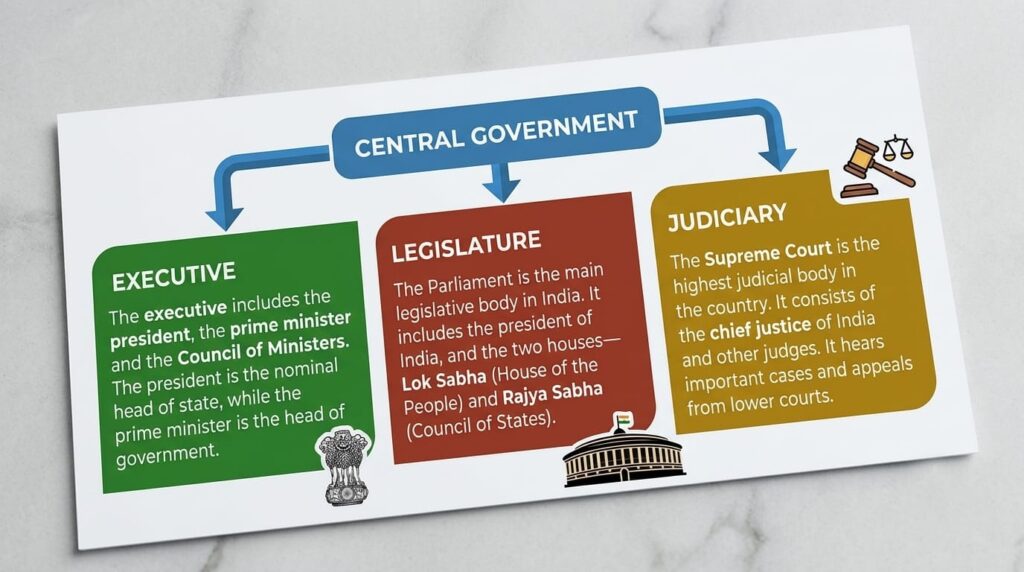
The three organs of government are the Legislature, Executive, and Judiciary.
Legislature: the legislature is the organ of the government responsible for making laws.
Executive: the executive implements the law.
Judiciary: the judiciary interprets the law and provides justice.
5. Describe the three levels of government in India.
Answer:
India has three levels of government: the Central (Union) Government, the State Government, and the Local Government.
The Central Government looks after national matters such as defence and foreign affairs.
State Governments manage subjects like education, agriculture, and police.
Local Governments include Panchayats in the rural areas and Municipalities in the urban areas.
6. Why is separation of powers necessary? What happens if one organ becomes too powerful?
Answer: Separation of powers prevents the misuse of authority by ensuring that no single organ controls the entire government. Each organ checks and balances the others. If one organ becomes too powerful, it may misuse its authority, weaken democracy, violate citizens’ rights, and create an unfair system where accountability and justice are compromised.
7. Does decentralisation make governance more democratic? Justify your answer.
Answer: Yes, decentralisation makes governance more democratic because it transfers power to local governments. It allows people to participate in decision-making and ensures that local problems are solved more effectively. Local representatives understand the needs of their communities better, making governance more transparent, accountable, and responsive to the people.
8. Describe the structure of the Central Government in India.
Answer: